
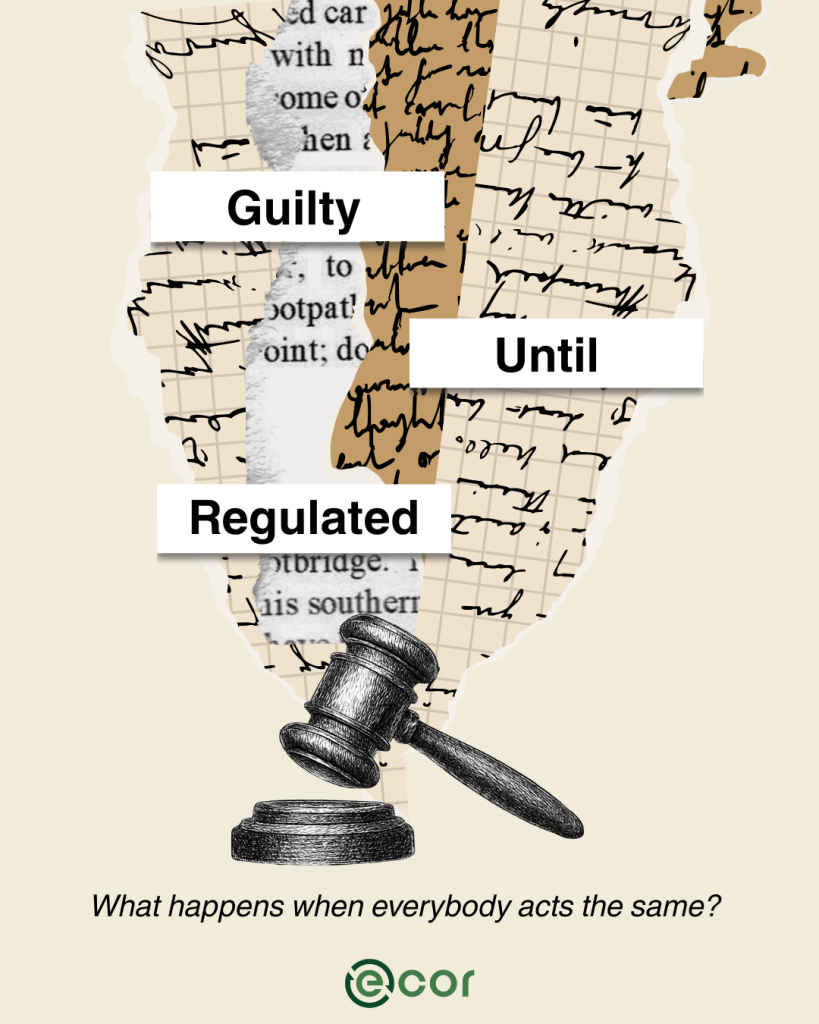
“If it ain’t broke, don’t fix it” has shaped industries for decades. History shows that what looks “not broken” often hides serious environmental and health risks. Time and again, we see the same cycle: a material becomes standard, its dangers emerge, industries resist change, and regulation finally forces action. Asbestos, lead paint, and even the shift from incandescent bulbs to LEDs all followed this pattern [1] [2] [3]. Early adoption, denial, lobbying, and eventually, accountability.
Today’s panel manufacturing industry is no different. It’s no longer enough to offer competitive pricing. Companies must meet rising expectations around sustainable manufacturing, environmental compliance, and consumer health. According to the EPA, pressed wood products remain the largest source of formaldehyde in homes [4]. With the EU’s 2023 regulation tightening emissions to 0.062mg/m3 by 2026 [5], the industry faces a major shift toward non-toxic, sustainable materials.
Just like past industries, resistance is already visible. The EU’s 2023/1115 deforestation-free regulation has been met with lobbying and pushbacks, despite clear evidence‑ of environmental harm [6]. The cycle repeats: delay, deny, defend, until regulation makes change unavoidable.
Once regulation hits, companies scramble to adapt, searching for circular economy solutions, renewable feedstocks, and low-impact manufacturing alternatives. So why does meaningful change take so long? Economic risk, first-mover disadvantage (Supply-chain immaturity) and lack of consumer awareness. The uncomfortable truth is that many industries only innovate when they’re forced to.
This is the essence of “Guilty until regulated.”
ECOR has watched this cycle unfold across the panel industry, from formaldehyde to deforestation. Instead of waiting for regulations to dictate the future, we chose to lead it. Years of R&D have resulted in a strong, sustainable, circular material made from an abundant feedstock: agricultural straw, with ultra-low VOC emissions. No toxic adhesives. No harmful emissions. Just responsible, future-ready manufacturing.
The planet is signaling that the old way of doing things is over. ECOR encourages more companies to embrace sustainable materials, circular design, and environmentally responsible manufacturing. We do this, not because regulation demands it, but because the future does.
[1] https://www.cancer.gov/about-cancer/causes-prevention/risk/substances/asbestos
[2] https://www.cdc.gov/lead-prevention/prevention/?CDC_AAref_Val=https://www.cdc.gov/nceh/lead/prevention/
[3] https://www.energy.gov/eere/ssl/led-basics
[4] https://www.epa.gov/indoor-air-quality-iaq/what-should-i-know-about-formaldehyde-and-indoor-air-quality
[5] https://single-market-economy.ec.europa.eu/news/chemicals-eu-restricts-exposure-carcinogenic-substance-formaldehyde-consumer-products-2023-07-14_en
[6] https://www.greenpeace.org/static/planet4-eu-unit-stateless/2021/06/8c8d1fac-2021-06-24-sabotage-companies-lobby-against-eu-protection-worlds-forests.pdf