
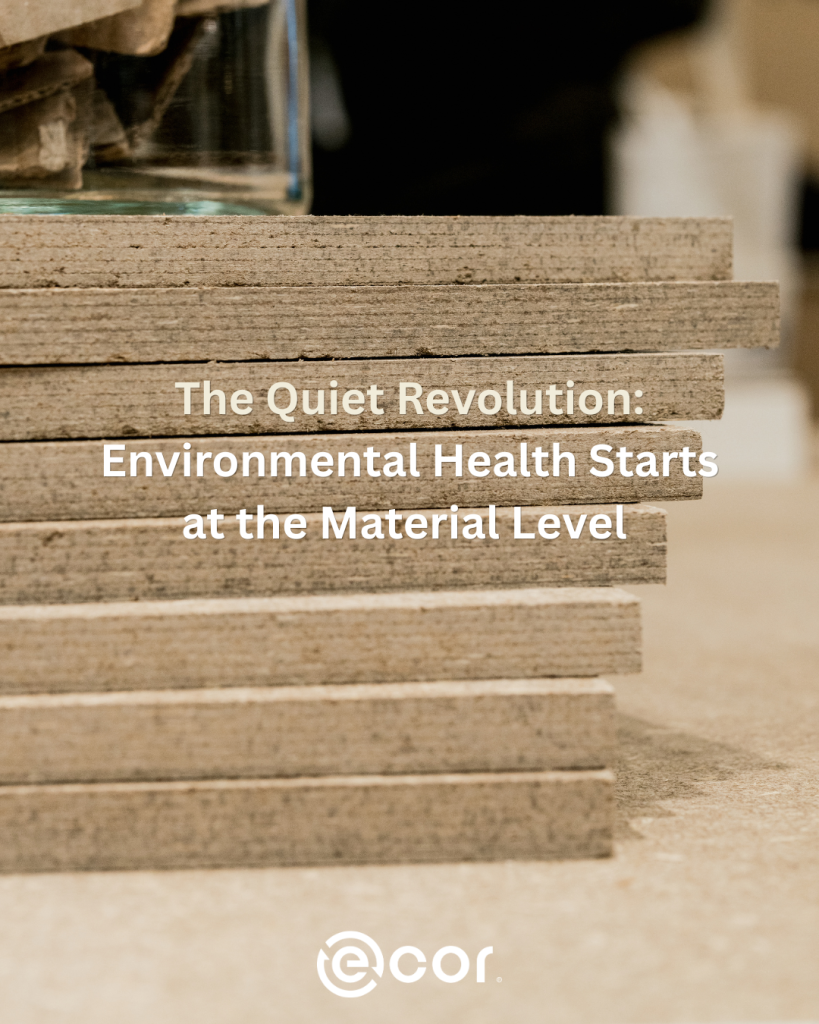
The quality of the air we live with is decided long before we ever step inside a building. Some of the most important environmental health decisions are made before construction even begins. Yet most building conversations still focus on how energy is used: efficiency, electrification, and reducing operational emissions over time. What receives far less attention is what happens before a building is occupied, or a product enters use. The materials chosen at the start of a project shape indoor environments and human exposure long before performance is measured [1][2].
Materials carry their impact upfront. The substances introduced during extraction, processing, manufacturing, and finishing are embedded into products before a building is occupied. Many commonly used material systems rely on synthetic binders, resins, and chemical additives to achieve performance [3]. These inputs can release volatile organic compounds (VOCs) and other emissions into indoor environments over time, directly affecting air quality and occupant exposure [1][4].
Material impacts extend beyond performance. They directly influence how indoor environments feel and function over time. Durability, maintenance needs, and air quality are all shaped by material choices. Factors like temperature, humidity, and wear can affect how materials release or retain compounds, making stability and predictability critical for maintaining healthy indoor conditions [2][5]. Materials are no longer just passive components. They actively shape long-term environmental quality and human well-being.
Material composition adds another layer to this conversation. Systems built from multiple synthetic inputs or unclear chemical formulations can make it difficult to fully understand what is present within a finished product. This lack of transparency makes it harder to evaluate potential impacts on indoor air quality and occupant exposure [4][6]. In contrast, materials designed with fewer inputs and simpler compositions are easier to assess, specify, and trust, especially as transparency becomes a growing expectation.
These shifts are already changing how materials are evaluated. Greater attention is being placed on indoor air quality, chemical transparency, and human exposure in building standards and design decisions [1][6]. Rather than making small adjustments to existing systems, the emphasis is shifting toward rethinking how materials achieve strength, durability, and performance without relying on unnecessary chemical complexity [3][7].
For ECOR, this shift toward healthier material systems closely reflects how products are designed and evaluated. Performance is not treated as a single moment at installation, but as something that must remain stable and safe over time. By designing panels with fewer added inputs and relying more on inherent material properties, ECOR reduces unnecessary chemical complexity. This approach supports healthier indoor environments, clearer material specifications, and greater confidence for architects and manufacturers who need materials to perform predictably across different environments and use cases.
As building strategies continue to evolve, materials science is becoming a more practical part of decision-making, not just a technical one. Many of the most consequential environmental health outcomes are embedded early in the materials selected to shape indoor spaces for decades. Energy efficiency will always matter, but how materials are engineered and what they contain is becoming just as important. In many cases, the quality of an indoor environment is largely determined before construction even begins. Materials don’t just build spaces. They define the conditions inside them.
Sources