
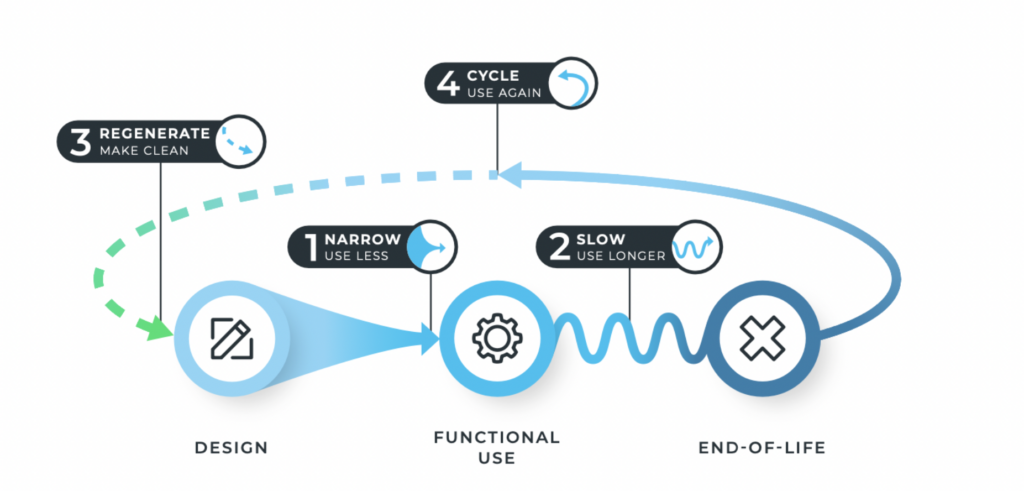
The World Business Council for Sustainable Development (WBCSD) and One Planet Network is developing a new protocol to help businesses share with stakeholders how circular they are. The new standards, set to launch in 2026 will provide a roadmap for what metrics to use, how to measure progress, and how to disclose it based upon policy frameworks and science-based targets.
At least 35 major Global brands including from Amazon, Volkswagen, Apple, BASF, Chevron, Shell and VF Corporation, as well as major environmental groups and governments are supporting the initiative to create the Global Circularity Protocol for Business (GCP). A September impact analysis of the proposed GCP standards projected that over thew next 25 years it would reduce carbon emissions by 7% annually (1.5% x the worlds current emissions); prevent the waste of 120 billion tons of materials, and the reduction of up to 76 gigatons of CO2 equivalent.
To create a pathway for success, the GCP follows the Greenhouse Gas (GHG) protocols established in 1998 breaking down emissions into Scopes 1-3. This framework has been adopted by 9 out of 10 fortune 500 companies, and world leaders used it to develop the Paris Agreement global emissions reduction targets.
The protocol is currently moving through impact analysis, corporate performance and accountability systems, policy framework and science-linked targets. An early version of the protocols was refined by stakeholders in November at COP 30 in Brazil, with a goal to make the GDP applicable across all regions and industries.
Additional momentum for circularity was created in May by the Geneva based International Standards Organization (ISO) who issued its ISO-59000 series of circular economy standards introducing a universal frameworks for defining, measuring, reporting, and enacting circular economy practices. This means that instead of the GCP adding yet another requirement to the alphabet soup of sustainability compliance, it will be fully incorporated into existing standards established by the European Union as well as the International Standards Organization.
The new protocols represent a much-needed rallying call to action for corporations. According to the 2012 Circularity Gap Report, if the world’s businesses advance circular economies by double, they can unlock $4.5 trillion in growth, add 6 million jobs, protect 12 million acres of arable land and reduce CO2 by 39% by 2032. There is much work to be done to get there as current estimates put the world’s companies at less than 9% circular.
ECOR applauds these new science-based circularity standards, and we look forward to participating as they move towards adoption.