
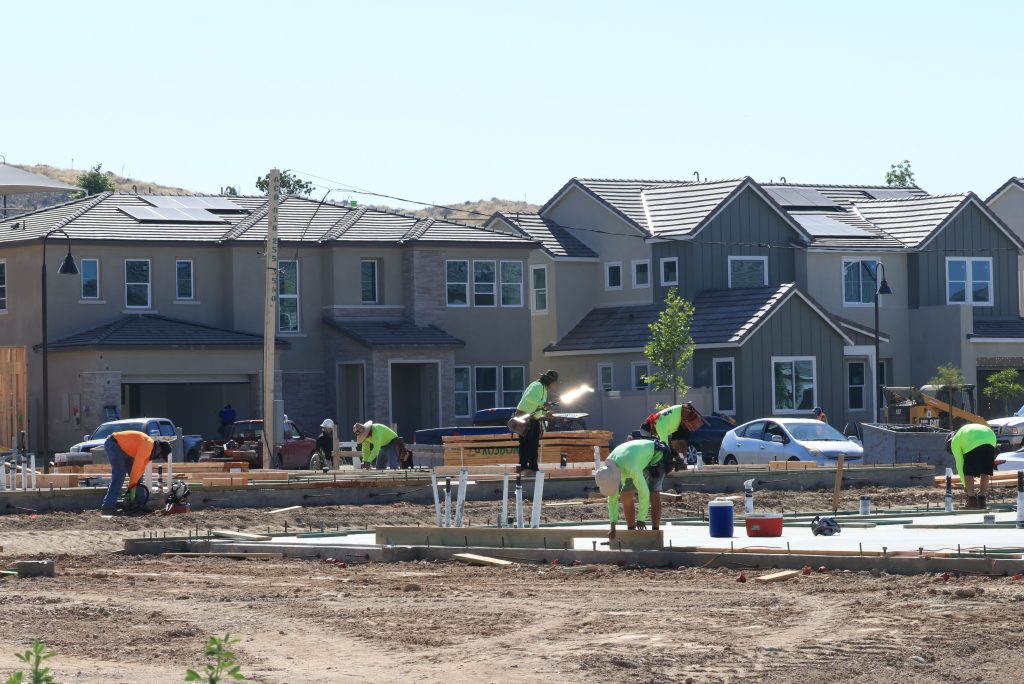
The world needs more housing than it has ever needed before, and it needs that housing fast. Every day, an estimated 12.7 million square meters of new floor area goes up somewhere on the planet, roughly the equivalent of building an entire city the size of Paris almost every week [1]. Half of all the buildings that will exist by 2050 have not been built yet [1]. That is either the largest opportunity the built environment has ever had, or the largest missed one, and which it becomes depends almost entirely on a question most housing policy conversations still treat as secondary: what are we going to build all of it out of?
A new report from the UN Environment Programme and the Global Alliance for Buildings and Construction makes the stakes plain. Buildings now account for nearly half of global material extraction and more than a third of global emissions, and decarbonization in the sector has slowed even as the affordability crisis deepens [1]. The report’s framing is worth sitting with. Climate action in buildings does not create tension with affordable housing; it is increasingly the same project. Lower carbon buildings tend to be cheaper to run, more resilient to energy price shocks, and healthier to live in [1]. The places struggling hardest to house people are often the same places where construction decisions are locked in decades of avoidable cost.
If that is the demand side of the problem, the supply side is just as structurally stuck. A separate effort out of Singapore offers a useful diagnosis. Working with CapitaLand and the Climate Group’s ConcreteZero initiative, Singapore built the first market-wide benchmark for the embodied carbon of concrete, covering roughly two-thirds of the country’s market [2]. The finding underneath the benchmark was not that lower-carbon materials are unavailable. They found the opposite; lower carbon concrete already exists and is commercially viable [2]. What is missing is a system that makes specifying it the default, rather than the exception. As the report’s authors put it, the unresolved question is no longer whether lower carbon materials exist, but whether procurement, financing, and certification systems are built to demand and deploy them [2].
That gap between availability and adoption is exactly where material sources start to collide with regulation, and Europe is about to test that collision directly. The EU Deforestation Regulation, which requires companies to trace covered commodities back to deforestation-free origins, is now scheduled to apply to large and medium-sized companies by the end of this year, with smaller timber sector operators following next summer [3]. The European Commission has spent the past several months simplifying the rules’ administrative mechanics, shortening declarations, introducing a grouping function for smaller operators, and implementing a more workable information system, but the underlying requirement has not softened [3]. Companies sourcing wood-based materials for the EU market will still need real traceability, not paperwork that merely looks like it.
Read together, these developments describe one problem wearing three different jackets. The world needs an extraordinary volume of new construction, much of it for people who cannot afford the energy and material premiums that conventional building products carry. The materials capable of meeting that need at lower carbon cost already exist, but the systems that would make them the default instead of the exception are still being built. And the raw material story behind those products, where the fiber came from, what forest or field it touched, is becoming a regulatory requirement rather than a marketing choice.
This is the frame ECOR has been operating inside long before it had this much company. Manufacturing panel products from agricultural and urban waste fiber rather than virgin timber sidesteps the deforestation traceability question almost entirely, because there is no forest in the supply chain to trace. It also answers the procurement gap Singapore’s benchmark surfaced, a lower embodied carbon material that does not require a price premium to specify. And it speaks directly to the affordability tension UNEP’s report describes, since a building material’s life cycle cost is inseparable from what it took to produce in the first place.
None of this means the systemic fixes researchers are calling for; better benchmarks, clearer certification, and financing that reward lower carbon choices, are unnecessary. They are exactly the infrastructure the industry needs. But the companies already building products that do not require a policy fix to make sense are not waiting on that infrastructure to catch up. The housing the world needs over the next 25 years will be built from something. The question the next year of regulation, benchmarking, and reporting will keep asking is simply whether the industry chooses materials that pass that test now, or scrambles to find them later.
Sources
[1] UN Environment Programme, “Climate action key to affordable housing, but buildings decarbonisation stalls,” May 2026. https://www.unep.org/news-and-stories/press-release/climate-action-key-affordable-housing-buildings-decarbonisation
[2] World Economic Forum, “Why measuring material emissions is key to cutting carbon in the built environment,” May 2026. https://www.weforum.org/stories/2026/05/measuring-materials-emissions-key-to-cutting-carbon-built-environment/
[3] Lewis Silkin, “EU Deforestation Regulation: The European Commission’s Simplification Push,” May 2026. https://www.lewissilkin.com/insights/2026/05/13/eu-deforestation-regulation-the-european-commissions-simplification-push-102mshv