
The EPA-funded National Human Activity Pattern Survey found that Americans spend roughly 87 percent of their time inside buildings and another 6 percent inside vehicles. The air in your home matters more to your daily VOC exposure than almost anything happening outside, and it is one of the few environmental variables you can control. Here is what research supports, ordered by the impact each step makes.
Start with the source
Removing a pollutant at its origin does more than any amount of filtering afterward.
Ventilate while you cook. Cooking is the largest source of fine particles and nitrogen dioxide in most homes, and gas burners raise indoor NO₂ well above electric or induction cooking. Lawrence Berkeley National Laboratory research found that ducted range hoods vented outdoors remove roughly 80 to 95 percent of burner emissions, while recirculating hoods do not remove combustion gases at all. Use the hood every time, not just when something smokes, and cook on the back burners where capture is strongest.
Let new materials breathe. Emissions from particleboard, MDF, and hardwood plywood peak when a product is new and decline over time, with decay half-lives of roughly one and a half to two years in the chamber studies behind the EPA’s Formaldehyde Indoor Air Model. Heat and humidity push emissions higher. Ventilate hard for the first several weeks after new cabinetry, flooring, or furniture arrives, and keep relative humidity between 30 and 50 percent.
Ask what a product is made of. Composite wood sold in the United States must meet EPA TSCA Title VI limits, which match California’s CARB Phase 2 standard, and compliant products are labeled. That label is a floor, not a ceiling: it confirms a product stays under a limit, not that it was made without added formaldehyde. Products declared as no-added formaldehyde, or tested under CDPH Standard Method v1.2, tell you considerably more. Ask the retailer for the test results.
Then dilute and filter what remains
Increase air exchange. Ventilation is the most reliable way to reduce gases that filters handle poorly. Opening windows on opposite sides of a room for ten to fifteen minutes turns over indoor air quickly. In tighter buildings, run kitchen and bathroom exhaust on a schedule.
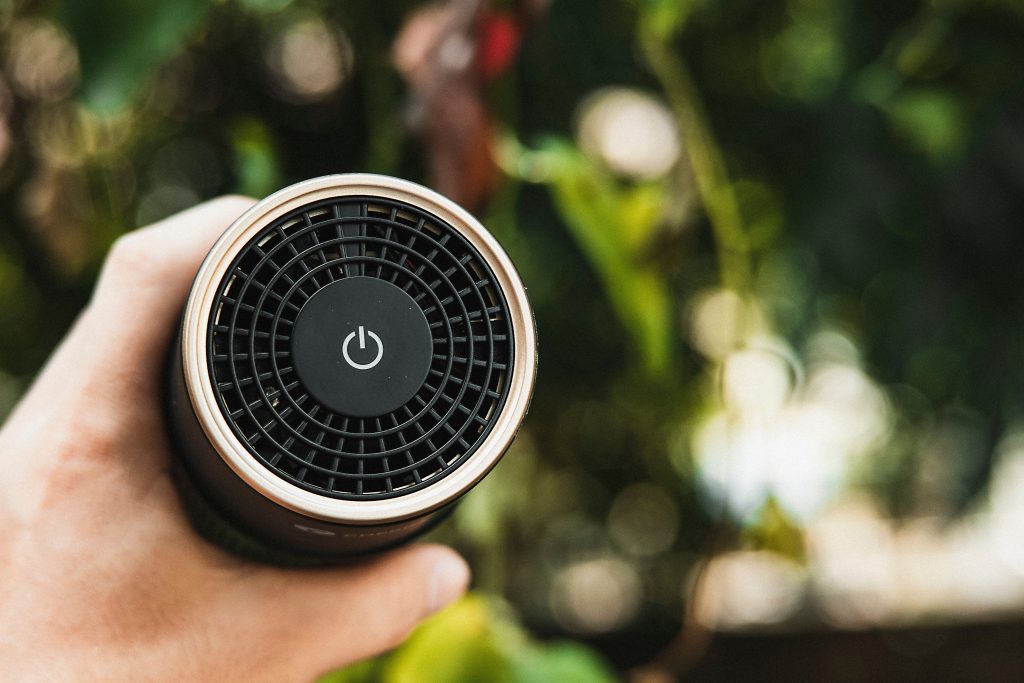
Run a portable HEPA cleaner where you sleep. This has some of the strongest evidence of any consumer step. A randomized trial among children with asthma measured 60 percent lower fine particle levels in sleeping areas of HEPA homes, and the UGAAR randomized controlled trial found a 29 percent average reduction in indoor PM2.5. Size the unit to the room using its clean air delivery rate, run it continuously on low, and replace filters on schedule. In the Mongolia trial, effectiveness fell from 40 percent to 15 percent after about five months of use.
Know the limits of carbon filters. HEPA media captures particles, not gases. Formaldehyde and other VOCs require activated carbon, and results are mixed: treated carbon filters performed well in a 2024 Building and Environment study, while a review in Applied Sciences notes that ordinary carbon struggles at typical indoor concentrations and saturates over time. Useful as a supplement, not a substitute for source control.
Skip the houseplants, at least for this. Keep them because you enjoy them. Cummings and Waring reviewed 196 experiments in 2020 and found that potted plants remove VOCs orders of magnitude more slowly than normal building air exchange. Matching two open windows would take between ten and one thousand plants per square meter.
If you specify or design buildings
Write emissions criteria into the specification rather than leaving them to substitution. CDPH Standard Method v1.2 is the primary North American VOC emissions standard, referenced by LEED v4 and v4.1 and by WELL v2 Feature X06. Request the full test report rather than a certificate number, ask how a low-emission result was achieved, since a panel can meet a threshold either by changing its chemistry or by being sealed, and consider the material’s full service life rather than only its first ten days in a chamber.
Where ECOR fits
ECOR panels are made through a wet process that blends cellulose waste fibers with water and reactivates the lignin already in the fiber. No added binders, no added glues, and therefore no added formaldehyde to off-gas later. The panels are independently verified by Berkeley Analytical for no added urea formaldehyde, hold SCS Global Indoor Advantage Gold certification, and are USDA Certified Biobased. We share those results because material choices are health choices, and you deserve to see the evidence rather than take our word for it.
You do not need to renovate this weekend. Open the window, turn on the hood, put a HEPA unit in the bedroom, and know how to ask better questions the next time you buy a panel or a piece of furniture.
Resources
EPA, Formaldehyde Emission Standards for Composite Wood Products. What the TSCA Title VI label means and which products it covers. epa.gov/formaldehyde
California Air Resources Board, Composite Wood Products FAQ: Labeling. How to read compliance labels on panels and finished goods. ww2.arb.ca.gov
CDPH Standard Method v1.2. The VOC emissions test method referenced by LEED v4/v4.1 and WELL v2. Full method PDF available from cdph.ca.gov.
AHAM Verifide clean air delivery rate directory. Independently verified CADR ratings for sizing a portable air cleaner to a room. ahamverifide.org
EPA Guide to Air Cleaners in the Home. Plain-language guidance on filter types, sizing, and maintenance. epa.gov/indoor-air-quality-iaq
ASHRAE Standard 62.2. Residential ventilation and indoor air quality requirements, useful when specifying mechanical ventilation.
Living Future Declare label and mindful MATERIALS. Ingredient-transparency databases for specifiers evaluating material health.
AirNow.gov. Outdoor air quality index by ZIP code, to know when opening windows helps and when it does not.
Sources
Klepeis, N.E., et al. “The National Human Activity Pattern Survey (NHAPS): A Resource for Assessing Exposure to Environmental Pollutants.” Journal of Exposure Analysis and Environmental Epidemiology 11 (2001): 231–252.
Cummings, B.E., and Waring, M.S. “Potted Plants Do Not Improve Indoor Air Quality: A Review and Analysis of Reported VOC Removal Efficiencies.” Journal of Exposure Science & Environmental Epidemiology 30 (2020): 253–261.
Barn, P., et al. “The Effect of Portable HEPA Filter Air Cleaners on Indoor PM2.5 Concentrations and Second Hand Tobacco Smoke Exposure Among Pregnant Women in Ulaanbaatar, Mongolia: The UGAAR Randomized Controlled Trial.” Science of the Total Environment 615 (2018): 1379–1389.
Riederer, A.M., et al. “Effectiveness of Portable HEPA Air Cleaners on Reducing Indoor PM2.5 and NH3 in an Agricultural Cohort of Children with Asthma: A Randomized Intervention Trial.” Indoor Air 31, no. 6 (2021).
Singer, B.C., et al. Performance of Residential Kitchen Exhaust Ventilation. Lawrence Berkeley National Laboratory, Indoor Environment Group.
U.S. Environmental Protection Agency. Formaldehyde Indoor Air Model — Pressed Wood Products (FIAM-PWP) User Guide, Version 2.0.
U.S. Environmental Protection Agency. Indoor Air Exposure Assessment for Formaldehyde. December 2024.
“Enhancing Indoor Air Quality: Examination of Formaldehyde Adsorption Efficiency of Portable Air Cleaner Fitted with Chemically-Treated Activated Carbon Filters.” Building and Environment (2024).
Bellat, J.-P., et al. “A Brief Review of Formaldehyde Removal Through Activated Carbon Adsorption.” Applied Sciences 12, no. 10 (2022): 5025.
California Department of Public Health. Standard Method for the Testing and Evaluation of Volatile Organic Chemical Emissions from Indoor Sources Using Environmental Chambers, Version 1.2. 2017.
U.S. Environmental Protection Agency. Formaldehyde Emission Standards for Composite Wood Products, 40 CFR Part 770 (TSCA Title VI)